



Most of the people who come to see me don’t walk in saying “my nervous system is dysregulated.” They say they’re tired but can’t sleep, calm on the outside but buzzing underneath, snapping at things that shouldn’t matter. They’ve usually been told it’s just stress, or just anxiety, and to push through. This post is for the moment before you have the language for it, when something feels off and you’re trying to understand why, and for the moment after, when you’re looking for something that actually helps.
Below is what dysregulation really is, how to tell it apart from anxiety, what the research says about acupuncture and the nervous system, and what settling it can look like in practice.
A few quick questions to help you notice patterns in how your body is holding stress. There are no right answers, and this isn’t a diagnosis, just a moment of reflection.
Rarely (0) · Sometimes (1) · Often (2) · Almost always (3)
What your answers suggest
Finding its rhythm. 0 to 5
Your answers suggest your nervous system is moving well between stress and rest. Keep tending the basics: movement, time outdoors, real moments of pause.
Running a little high. 6 to 11
Your answers point to a few signs your nervous system may be working harder than it needs to. This is common, and very workable, small daily practices and supportive care like acupuncture can help your body find its way back to balance.
Often in a heightened state. 12 to 18
Your answers suggest your nervous system may be spending a lot of time switched “on.” You’re not failing, your body has been carrying a lot. With the right support, it can relearn how to settle.
This is a self-reflection, not a diagnosis. If these patterns are affecting your daily life, please talk with a licensed provider. Curious whether acupuncture could help? Book a consult
What does a dysregulated nervous system feel like?
A dysregulated nervous system feels like being switched “on” even when nothing is actually wrong. You might feel wired and exhausted at the same time, unable to fully relax, settle, or power down at night. Your body keeps running its stress response, long after the stress itself is gone.
Here’s the underlying mechanics, because they’re worth understanding. Your autonomic nervous system runs automatically, below conscious control, and it has two branches: the sympathetic (“fight or flight”) and the parasympathetic (“rest and digest”). In a healthy, regulated system, you ramp up to meet a demand, a deadline, a near-miss on the subway stairs, then come back down once it passes. That flexibility, the ability to rise and fall, is the actual definition of a well-regulated nervous system.
In a dysregulated one, the comedown doesn’t fully happen. You stay braced. Over weeks and months, bracing starts to feel like your normal, so much so that genuine rest can feel unfamiliar, even uncomfortable. People describe it as forgetting how to relax, or feeling guilty when they try.
Physical signs: tight jaw, shallow breathing, gut flare-ups, poor sleep
The body tends to speak before we consciously register the pattern. Common physical signs include a jaw that’s clenched by mid-morning, breathing that sits high and shallow in the chest, a gut that flares with bloating or urgency under pressure, and sleep that’s light or interrupted, especially waking in the early hours and struggling to fall back asleep. You might also notice tension headaches, a racing or pounding heart at rest, cold hands, muscle tightness through the neck and shoulders, or feeling startled easily by ordinary sounds.
None of these are “all in your head.” They are the direct physiology of a system that hasn’t been given permission to stand down. When the sympathetic branch stays active, digestion is dialed back (the body deprioritizes it during “danger”), muscles stay primed, and the breath stays shallow and fast. The symptoms are the stress response, simply running longer than it should.
Emotional signs: on edge, flat, overwhelmed by small things
Emotionally, dysregulation often shows up as a short fuse, a constant sense of being on edge, or feeling flooded by things that objectively aren’t a big deal, a full inbox, a change of plans, a slow walker ahead of you. Some people experience the opposite: a flatness, a numbness, a hard time feeling much at all, or a sense of going through the motions. Both are the nervous system protecting you, just in different directions, one by staying revved, the other by powering down to conserve. Neither is a character flaw, and neither means you’re failing. They’re signals.
What causes nervous system dysregulation?
Dysregulation usually isn’t one event. It’s accumulation. Chronic overwork, ongoing stress without real recovery, broken sleep, big hormonal shifts (postpartum, perimenopause, thyroid changes), past trauma, illness, and the constant low-grade stimulation of modern life all ask the nervous system to stay alert far more than it was designed to.
Living in New York is its own factor. The noise, the pace, the always-reachable expectation, the sense that slowing down means falling behind, all of it keeps the sympathetic system gently revved up. For many of the people I see here in Chelsea, there’s no single crisis to point to. There’s just years of running a little high, without the space to fully come back down.
The biology underneath: a stress response that won’t switch off
When your brain perceives a demand, it activates two systems: the sympathetic nervous system (fast, via adrenaline) and the HPA axis, the hypothalamic-pituitary-adrenal pathway that releases cortisol, your main stress hormone. In short bursts, this is healthy and adaptive. The problem is chronicity. When the stressor never fully lifts, cortisol and sympathetic activity stay elevated, and the body loses its natural rhythm of rising and falling.
One of the clearest windows into this is heart rate variability, or HRV, the tiny, natural variation in time between your heartbeats. A well-regulated nervous system produces higher HRV, because it’s constantly making micro-adjustments and the parasympathetic “brake,” carried largely by the vagus nerve, is working well. Chronically stressed, dysregulated systems tend to show lower HRV. This matters because HRV is measurable, it’s not just a feeling, and it’s the exact marker researchers use to study whether something is genuinely shifting the nervous system, which we’ll look at in the research below.
Is it a dysregulated nervous system or anxiety?
They overlap, but they aren’t the same thing. Dysregulation describes the state of your autonomic nervous system, how well it moves between stress and rest. Anxiety is a clinical condition with its own diagnostic criteria, often including persistent worry and specific cognitive and emotional patterns.
In practice, the line between them can blur, and that’s okay. A dysregulated nervous system can feel a lot like anxiety, and anxiety can keep the system dysregulated. The two feed each other. What acupuncture offers is support for how your body holds stress, alongside the care of a physician or therapist, never in place of it. If your symptoms are affecting your daily life, talking with your physician or therapist is a real and important step, and acupuncture can sit right alongside it. Many of my patients do both, and they work beautifully together.
Regulated vs dysregulated vs clinical anxiety
| Regulated | Dysregulated | Clinical anxiety | |
|---|---|---|---|
| What it feels like | Can rev up, then settle | Stuck “on,” wired-tired, or flat | Persistent worry, dread, often with physical symptoms |
| How long it lasts | Passes with the trigger | Lingers well after the stressor | Ongoing, most days, for weeks or more |
| Body signs | Tension that releases | Tension that stays, poor sleep, gut flare-ups | Similar body signs, plus marked distress |
| What helps | Normal rest and recovery | Nervous-system support, lifestyle shifts, bodywork | Professional care, often therapy and/or medication, sometimes alongside supportive care |
Use this as a starting point for self-awareness, not a diagnosis. If you see yourself in the right-hand column, please reach out to a licensed provider.
Can acupuncture calm the nervous system?
Yes, and importantly, there’s measurable evidence for it, not only how people say they feel afterward. The clearest proof comes from studies using heart rate variability, that objective marker of autonomic balance. Across multiple reviews, acupuncture has been shown to shift HRV in the direction of a calmer, more parasympathetic (“rest and digest”) state. The effects are real and measurable, and researchers describe them as modest, which is an honest and useful way to frame it: this is meaningful support, not an instant off-switch.
How does acupuncture calm the nervous system?
Acupuncture works, in part, by influencing the autonomic nervous system, guiding the body out of “fight or flight” and toward “rest and digest.” When fine needles are placed at specific points, the body often responds within minutes with slower breathing, softening muscles, a drop in heart rate, and a noticeable release of that internal bracing. Many people fall asleep on the table, which is itself a sign the parasympathetic system has taken over.
Researchers studying how this happens point to several overlapping pathways. Needling stimulates sensory nerves in the skin and muscle, which send signals into the spinal cord and brain and appear to modulate the autonomic nervous system and the vagus nerve. Acupuncture also prompts the release of the body’s own regulating chemicals: endorphins and other endogenous opioids (we know these are involved because opioid-blocking drugs reduce acupuncture’s effects), and locally, a molecule called adenosine that quiets pain signaling. Brain-imaging studies show acupuncture can influence activity in regions involved in stress, emotion, and the “default mode network,” the system active when the mind is ruminating. These mechanisms are still being mapped, and researchers are clear that more work is needed, but the throughline is consistent: acupuncture appears to act on the nervous system itself.
In Traditional Chinese Medicine, we understand a revved-up nervous system through patterns. The one I see most is Liver qi stagnation, the result of stress and pressure that hasn’t been able to move, which shows up as tension, irritability, and a sense of being wound up. When that stagnation lingers, it can generate heat, and that’s often where the hot, agitated, can’t-switch-off quality comes from. Underneath, the Heart is frequently involved: in Chinese medicine the Heart houses the shen, our spirit or mind, and when Heart blood or yin runs deficient, the shen isn’t well anchored, so sleep turns restless and the mind won’t settle. Over time, running hot this way can deplete our yin reserves (the classic wired-but-tired, waking in the early hours), and constant worry can weaken the Spleen, which is part of why digestion suffers too. Treatment aims to move the Liver qi, clear that heat, nourish and anchor the shen, and rebuild what’s been depleted, so the whole system can come back to balance.
These two perspectives, the biomedical and the Eastern, describe the same thing from different angles. One measures the vagus nerve and HRV; the other speaks of qi and shen. Both are pointing at a nervous system that has lost its rhythm, and both aim to help it find the way back.
There’s also something simpler happening in the room. For 30 to 40 minutes, you lie still in a warm room, cared for, with nothing to respond to and nowhere to be. For a system that never gets to stand down, that itself is part of the medicine.
What does the research actually show?
The evidence is encouraging and growing, and I’ll always be straight with you about where it sits. Most of it centers on heart rate variability (HRV), because it’s an objective, physiological measure of how balanced and adaptable your autonomic nervous system is. Higher HRV reflects a system that can shift flexibly between alert and rest, exactly what we’re working to restore.
The most recent and comprehensive look is a 2025 meta-analysis in Frontiers in Neuroscience that pooled 10 randomized controlled trials and 744 participants. It found that acupuncture significantly improved SDNN, a core HRV measure (SDNN reflects overall variability between heartbeats; higher values point to a more resilient, better-regulated nervous system), with a strong safety profile and no serious adverse events reported.[1] The authors describe the overall effect on autonomic function as modest, which is a fair way to put it: these are real, measurable shifts, not cures.
It doesn’t stand alone. A 2023 review in Complementary Therapies in Medicine examined needle acupuncture against sham (placebo) acupuncture and found that real acupuncture increased parasympathetic (“rest and digest”) tone significantly more than the placebo, suggesting the effect isn’t only the needling ritual but the needling itself.[2] An earlier systematic review reached similar conclusions about acupuncture’s influence on autonomic balance and HRV.[3]
Because dysregulation and anxiety overlap so often, the anxiety research is relevant too. A 2023 systematic review in Frontiers in Psychology analyzed 37 randomized trials of electroacupuncture for anxiety. Results were mixed across measures, one anxiety scale showed a significant reduction, another did not reach significance, but the authors concluded electroacupuncture can help relieve anxiety, while calling for further research.[4] That mixed-but-promising picture is typical of this field, and it’s exactly why I describe acupuncture as support rather than a guaranteed fix.
Taken together, the picture is consistent: acupuncture appears to nudge the nervous system toward its calmer, more regulated state, measured not just by how people feel, but by what their physiology is doing. It’s promising and still developing. I offer it as support, most often alongside the other things that support it, like movement, time outdoors, therapy, and medical care where it’s needed.
What a nervous system reset looks like at Senuri
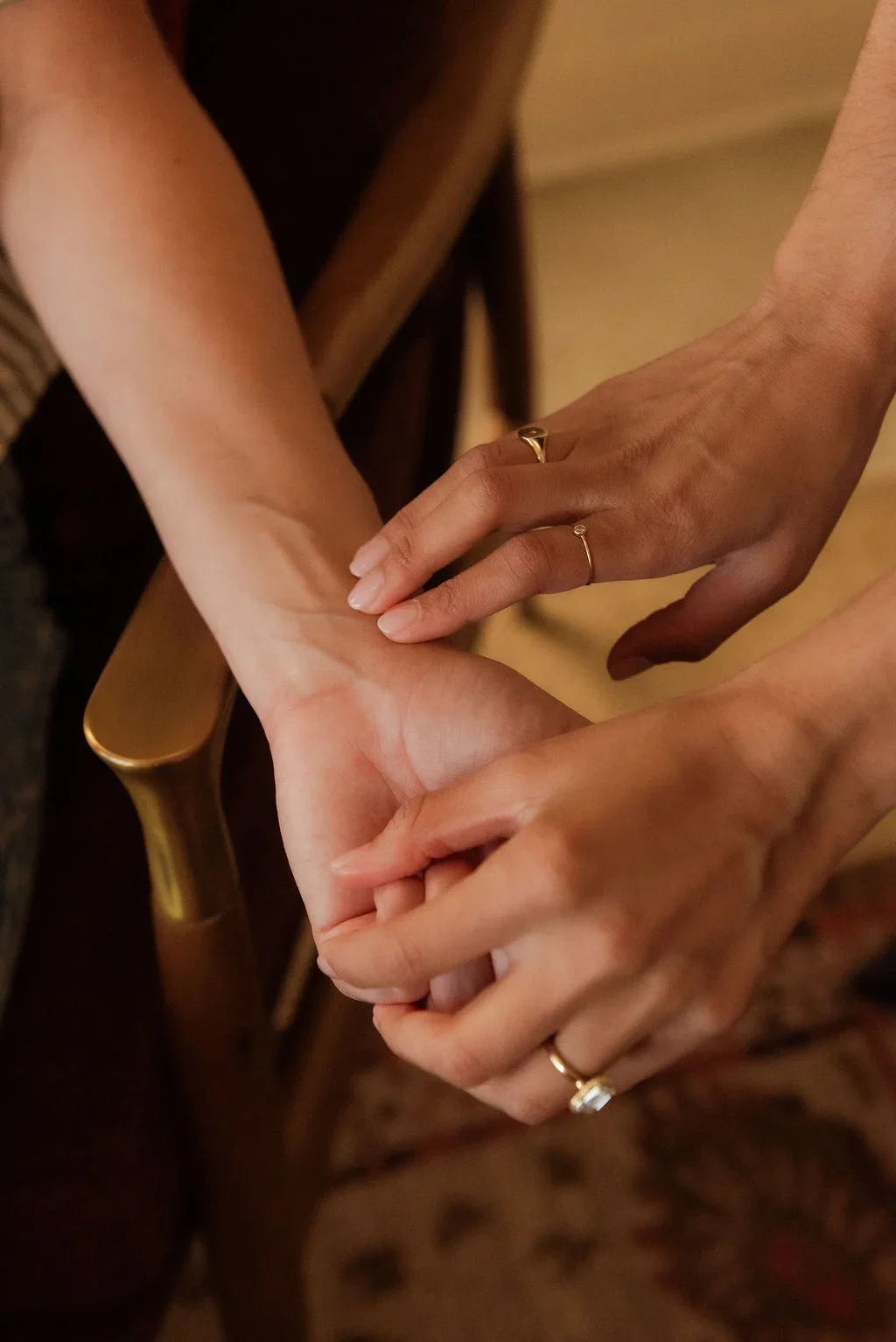
A session with me starts with listening and understanding. Before any needles, I take a full history and assess your nervous system the way Chinese medicine has for centuries, through your pulse, your tongue, your breathing, and the tension you’re carrying in your body, alongside everything you tell me about your sleep, cycle, digestion, and stress. My background as a physician assistant means I’m also thinking about the bigger picture, what else might be going on, what deserves a referral, and how acupuncture fits with any care you’re already receiving.
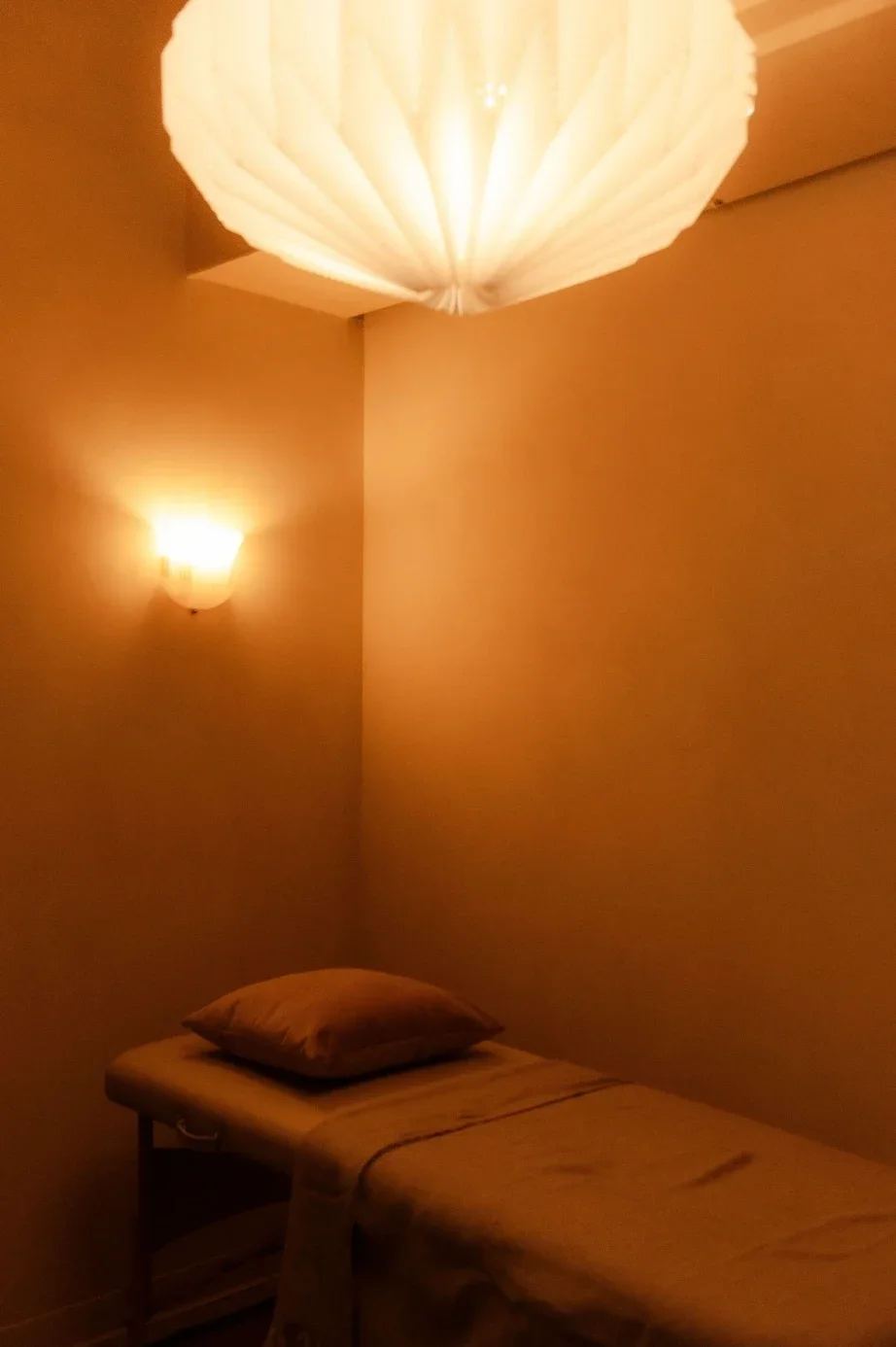
The studio and treatment rooms are part of the treatment, too. The studio was designed to feel like a sanctuary the moment you step in from the city, warm and sunlit, layered with terracotta and earthy tones, plants, and the soft scent of incense. The treatment rooms carry that same feeling, like a cocoon: gently warm, dimly lit, with candles glowing and soft music in the background. For most of my patients, simply lying there, held by the space, is the first time all day their body has been given permission to let go. The needles are hair-fine, and most people feel little more than a dull heaviness or a wave of calm as they settle in. Many drift off. That stillness, with nothing to respond to, is where the nervous system finally begins to unwind.
How many sessions does it take to feel more regulated?
Many people feel something after a single session, usually a deep, almost surprising calm that lasts a day or two. After a first visit, what I hear most is simply how relaxed they feel, often more relaxed than they can remember being in a long time.
But regulation builds. Because we’re helping the nervous system relearn how to settle, the deeper shifts come over a series of sessions rather than one. This mirrors what the body is actually doing: each session is a repetition, a chance to practice dropping into the parasympathetic state, and with repetition that state becomes more available on its own. As the weeks go on, the words change. People tell me they feel grounded in a way they haven’t before, fully back in their bodies, and that they didn’t realize how far they’d drifted from themselves. That’s the part that moves me most: it isn’t only symptom relief, it’s a reconnection to their own nature, a sense of coming home to themselves.
As a general guide, I usually suggest starting with weekly sessions for the first few weeks, so the body gets repeated practice dropping into that rested state, then spacing out as things stabilize. Your timeline depends on how long your system has been running on high, along with your sleep, your hormones, and everything else life is asking of you. This is a gradual process rather than a quick fix, and I’ll always be honest with you about what I’m seeing and what to expect.
Small ways to support regulation between sessions
What you do between sessions matters as much as the time on the table. Regulation isn’t built in the big gestures; it’s built in small, repeated signals of safety. A few simple places to start:
-
Lengthen your exhale. Breathe so the out-breath is longer than the in-breath for a few minutes a day. A long, slow exhale directly stimulates the vagus nerve and tips you toward the parasympathetic state, it’s one of the fastest, most reliable ways to signal safety to the body.
-
Protect the first and last 30 minutes of your day. No phone, no inbox, just a slower on-ramp and off-ramp. How you start and end the day sets the tone for your nervous system on either side of sleep.
-
Get morning light. A few minutes outside early helps anchor your circadian rhythm, which supports better sleep at night, and sleep is where the nervous system does much of its repair.
-
Watch the afternoon caffeine. Caffeine blocks the very calming signals (adenosine) your body uses to wind down, and it lingers for hours. If you’re wired-tired, a caffeine curfew in the early afternoon often helps.
-
Move, then let yourself rest. Gentle movement helps release stress, as long as you give the body real time to come down afterward. The recovery is as important as the effort.
-
Create one daily pause with no input. Even five minutes with no screen, no podcast, no task, teaches a stimulation-flooded nervous system that stillness is safe.
These are small by design. Regulation comes from small, repeated signals of safety, and those add up.

-
What is nervous system dysregulation?
Hint: Think about rhythm, the ability to rise and fall.
Show the answer
B. Dysregulation is when your autonomic nervous system gets stuck in a heightened (or shut-down) state instead of moving flexibly between stress and rest. It’s a pattern, not a diagnosis or a character flaw.
-
Which branch of your nervous system is the “rest and digest” one?
Hint: It’s the opposite of “fight or flight.”
Show the answer
B. The parasympathetic branch, carried largely by the vagus nerve, is your body’s calming “brake.” The sympathetic branch is “fight or flight.”
-
Is a dysregulated nervous system the same as anxiety?
Show the answer
B. Dysregulation describes the state of your autonomic nervous system; anxiety is a clinical condition with its own criteria. They often overlap, but they’re distinct, and if symptoms affect daily life, it’s worth speaking with a licensed provider.
-
What measurable marker do researchers use to study the nervous system’s balance?
Hint: It has to do with the time between heartbeats.
Show the answer
C. HRV is the tiny variation between heartbeats. Higher HRV generally signals a more flexible, better-regulated nervous system, and it’s the marker used in acupuncture research.
-
Based on current research, how is acupuncture’s effect on the nervous system best described?
Show the answer
B. Studies, including a 2025 HRV meta-analysis, show real, measurable but modest shifts toward a calmer, more parasympathetic state. Acupuncture is supportive, not a cure, and works best alongside your other care.
Frequently asked questions
Does acupuncture actually affect the nervous system?
Yes. Research using heart rate variability, an objective measure of autonomic function, shows acupuncture can shift the body toward a more parasympathetic, regulated state, with effects described as modest but real.[1] [2]
Is acupuncture safe?
Acupuncture performed by a licensed practitioner has a strong safety record, and the recent HRV meta-analysis reported no serious adverse events.[1] As with anything, it’s worth telling your practitioner about your full health history, which I always review.
Can I do acupuncture alongside therapy or medication?
Absolutely, and many people do. Acupuncture is a complement to your other care, not a replacement for it. I’m always glad to work alongside your physician or therapist.
How will I feel after a session?
Most people feel deeply relaxed, sometimes sleepy, occasionally a little tender at a point or two. That calm is the parasympathetic state taking over, and it’s exactly what we’re after.
References
- Acupuncture and autonomic nervous function: a meta-analysis of randomized controlled trials. Frontiers in Neuroscience, 2025. doi.org/10.3389/fnins.2025.1694110
- Acupuncture increases parasympathetic tone, modulating HRV: systematic review and meta-analysis. Complementary Therapies in Medicine, 2023. Tavistock & Portman repository
- Chung et al. Effect of Acupuncture on Heart Rate Variability: A Systematic Review. Evid Based Complement Alternat Med, 2014. PMC3944737
- Effectiveness of electroacupuncture on anxiety: a systematic review and meta-analysis of RCTs. Frontiers in Psychology, 2023. doi.org/10.3389/fpsyg.2023.1196177
None of this means something is wrong with you. It means your body has been carrying a lot, for a long time. With the right support, it can remember how to settle, and you can feel more at home in your own body. If you’re ready to begin, I’m now seeing patients in Chelsea.